Wike's Aides' Voter Information Scandal Rocks INEC Ahead Of 2027 Polls
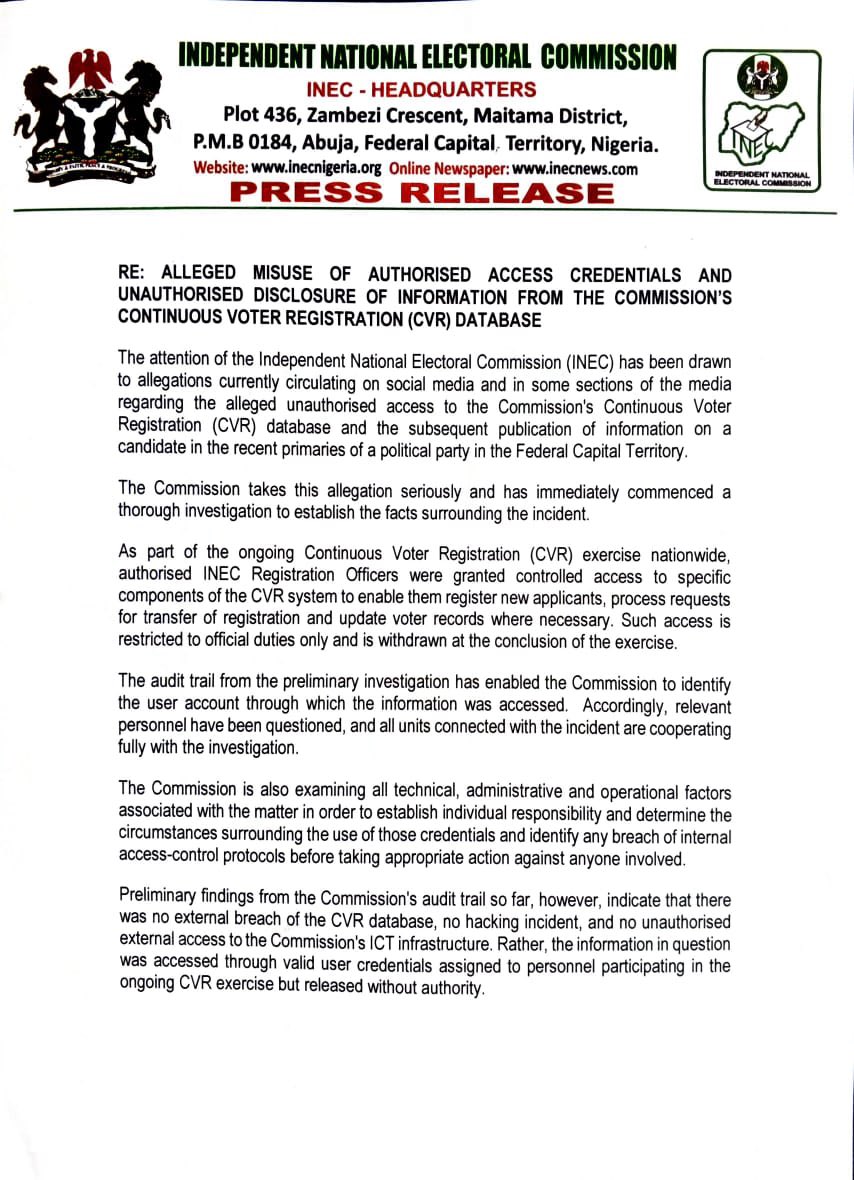
In a development that strikes at the heart of Nigeria’s electoral integrity, the Independent National Electoral Commission (INEC) has launched a sweeping investigation into the alleged misuse of official access credentials, leading to the unauthorized leak of sensitive voter information from its Continuous Voter Registration (CVR) database.
The controversy erupted after Lere Olayinka, media aide to Federal Capital Territory Minister Nyesom Wike, publicly shared detailed personal records of Nollywood actor and National Democratic Coalition (NDC) House of Representatives aspirant Emeka Ike.
The shared screenshots reportedly included Ike’s voter identification number, profile photograph, registration center, application details, and evidence of his recent transfer from Imo State to the FCT—information that appeared to originate from INEC’s restricted administrative portal.
In a strongly worded press statement issued on June 2, 2026, and shared via its official X handle @inecnigeria, INEC clarified that preliminary findings point to an internal breach rather than an external cyberattack.
Authorized registration officers had been granted limited, controlled access to parts of the CVR system for legitimate duties during the ongoing nationwide exercise.
However, these credentials were allegedly released without authority, allowing the retrieval and subsequent public disclosure of a single voter record.
No widespread compromise
Crucially, INEC emphasized that there was “no external breach, no hacking incident, and no unauthorized external access” to its broader ICT infrastructure.
The leak, it stressed, does not affect the personal data of over 90 million registered voters.
The Commission has identified the specific user account involved through audit trails, questioned relevant personnel, and is examining technical, administrative, and operational lapses.
The Department of State Services (DSS) has independently commenced its own probe, with INEC pledging full cooperation and warning that anyone found culpable will face appropriate legal action.
National Commissioner and Chairman of the Information and Voter Education Committee, Mohammed Kudu Haruna, urged the public to ignore unfounded speculations while investigations continue.
Public outrage and calls for accountability
The incident has ignited fierce public debate. Social media commentators, including user @AnewNaija, have demanded swift action, calling for Olayinka to be invited by the DSS to explain how he obtained the information.
Veteran journalist Reuben Abati also weighed in, insisting that such privileged access raises troubling questions about selective transparency and potential abuse of power.
Emeka Ike himself has condemned the act as “political rascality” and threatened legal action, highlighting the personal violation involved.
For many Nigerians, the episode feels deeply personal.
In a country where trust in electoral institutions has long been fragile, this breach—coming barely months before crucial elections—fuels fears of weaponized data, voter intimidation, and elite manipulation.
Nuances and broader implications
From one angle, INEC’s swift acknowledgment and internal audit demonstrate a degree of institutional responsiveness.
Yet critics argue it also exposes systemic vulnerabilities: how easily internal credentials can be shared or abused in Nigeria’s politically charged environment.
The CVR exercise, meant to strengthen democratic participation, now risks eroding public confidence instead.
This case raises profound questions about data protection under Nigeria’s laws, the boundaries between political operatives and state institutions, and the safeguards needed to prevent future leaks.
As the 2027 general elections loom, the stakes could not be higher. Will this incident lead to genuine reforms in access controls and accountability, or will it fade into another footnote of eroded trust?
INEC has promised to update the public on its final findings.
For now, Nigerians watch closely, hoping that transparency and justice will prevail over political expediency.
The integrity of the ballot—and the privacy of ordinary voters—hangs in the balance.
 news
news Presidency Brands Economist’s Tinubu Hate Claim Intellectual Fraud as Reforms Push On
 world
world Hegseth Declares Commanders Back in Charge with Major IG Reforms Across War Department
 news
news Suspected Cattle Rustlers Injure Youth in Isolated Bokkos Attack as Plateau Troops Respond
 world
world Trump Credits US Forces as Dozens of Iranian Terror Leaders Sent Straight to Hell
 politics
 Sowore Demands ₦500,000 Wage for INEC Staff, Threatens 2027 Election Boycott
How do you feel about this news?
Community Additions
Have a news tip, correction, or extra context about this story? Post it below instantly. All submissions appear live on this screen immediately.